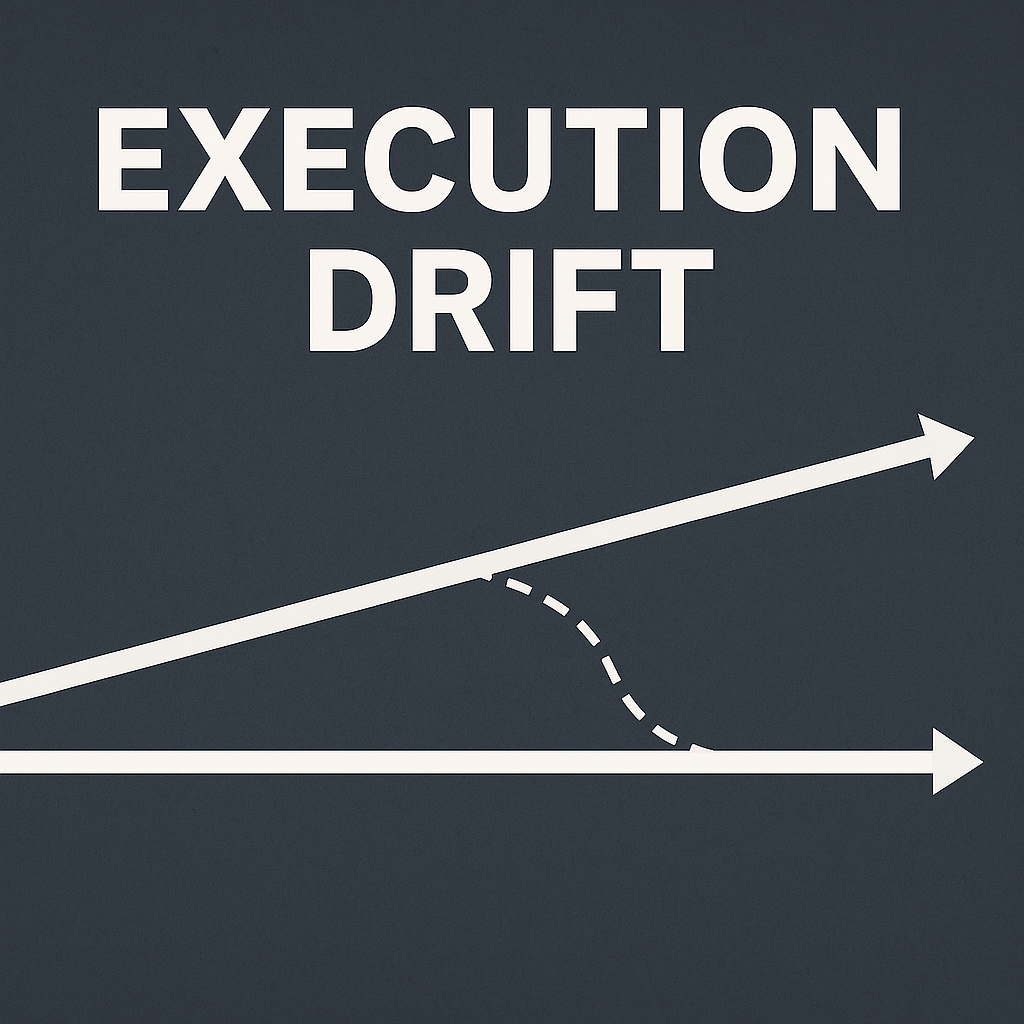
Every organization has a plan. Strategies are documented, dashboards are built, and leaders align on priorities. On paper, everything looks coherent. But somewhere between planning and delivery, something subtle happens: teams drift. Not dramatically, not maliciously — but consistently. Small deviations accumulate, assumptions shift, and the organization slowly moves away from its intended path.
This phenomenon is Execution Drift — the silent erosion of strategic intent. It’s one of the most common and costly challenges in business, yet it rarely gets named. Leaders see the symptoms: missed deadlines, inconsistent performance, unexpected variance, and the nagging sense that the organization is working hard but not necessarily working toward the same thing.
Execution Drift is not an execution failure. It’s a systems failure. And it’s far more predictable than most leaders realize.
Why Execution Drift Happens
Execution Drift emerges from the everyday realities of organizational life. It’s not caused by incompetence or lack of effort. It’s caused by the friction between strategy and reality.
1. Micro-Decisions Accumulate
Every day, teams make dozens of small decisions — prioritizing one task over another, responding to urgent issues, adjusting timelines, interpreting goals. Individually, these decisions seem rational. Collectively, they can shift the organization off course.
2. Local Priorities Override Global Intent
Teams naturally optimize for what’s in front of them. Sales focuses on closing deals. Product focuses on shipping features. Operations focuses on stability. These local optimizations often conflict with the broader strategy, creating drift.
3. Assumptions Age Quickly
A strategy is built on assumptions — about customers, markets, capacity, and timing. As conditions change, assumptions become outdated. If teams don’t revisit them, execution drifts even when effort remains high.
4. Communication Decays Downward
Leaders may be aligned at the top, but alignment weakens as strategy cascades. By the time it reaches frontline teams, the message is often diluted or interpreted differently. Drift begins where clarity ends.
5. Metrics Lag Behind Reality
Dashboards show what happened, not what’s happening. By the time drift shows up in metrics, it’s already embedded in the system.
The Cost of Execution Drift
Execution Drift is expensive — not in a single moment, but in cumulative impact.
Slower Progress
Teams work hard but move in slightly different directions, reducing overall velocity.
Inconsistent Results
Outcomes vary across teams, regions, or product lines because execution isn’t uniform.
Forecast Variance
Plans built on aligned assumptions break down when execution diverges.
Strategic Dilution
The organization ends up doing many things “pretty well” instead of a few things exceptionally well.
Cultural Friction
Teams blame each other for delays or inconsistencies, eroding trust.
Execution Drift is the tax organizations pay when strategy and execution are not continuously synchronized.
How to Detect Execution Drift
Execution Drift is subtle, but it leaves clues. Leaders can spot it by asking:
- Are teams interpreting priorities the same way?
- Are we seeing variance in execution across functions or regions?
- Are decisions taking longer than expected?
- Are we revisiting assumptions regularly — or operating on outdated ones?
- Are teams making trade-offs that contradict the strategy?
- Do we see “shadow priorities” emerging that weren’t part of the plan?
If the answers vary by team or function, drift is already underway.
Closing the Execution Drift
Execution Drift can’t be eliminated entirely — but it can be dramatically reduced. High-performing organizations build systems that continuously realign strategy and execution.
1. Reconnect Strategy and Operations Weekly
Annual planning creates clarity. Weekly operating rhythms maintain it.
2. Make Assumptions Explicit — and Revisit Them
Most drift comes from outdated assumptions. Leaders should document what they believe, why they believe it, and what would change their mind.
3. Create a Single Source of Truth
When teams use different data, drift accelerates.
4. Align Local Decisions With Global Priorities
Teams should be able to answer: “How does this decision support the strategy?”
5. Reduce Work in Progress
Too many priorities create fragmentation. Limiting active work increases focus and reduces drift.
6. Build Cross-Functional Accountability
Execution Drift thrives in silos. Shared goals and shared metrics keep teams connected.
7. Shorten Feedback Loops
The faster teams see the impact of their decisions, the less drift accumulates.
The Board’s Role in Preventing Drift
Boards often see the symptoms of Execution Drift — missed targets, inconsistent performance, strategic wobble — but not the root cause.
Boards should ask:
- How do we ensure strategy stays connected to execution?
- Where do we see variance across teams or regions?
- How often are assumptions revisited?
- What operating rhythms keep teams aligned?
- Where are we seeing local optimization over global intent?
Final Thought
Execution Drift is inevitable — but unmanaged drift is optional. The best organizations don’t just set strategy. They continuously realign it. They build systems that keep teams connected, assumptions current, and decisions coherent. They recognize that execution is not a straight line — it’s a constant course correction.
Because in the end, strategy sets direction. Execution Drift determines whether you stay on course.